Venus
Intro
Duvida.. o que é especifico de um produto de software
Product Manager Artifacts: https://gemini.google.com/app/f6fe1ee9b932b554
-
Product Roadmap: A high-level visual plan that outlines the product’s vision, direction, priorities, and progress over time. It helps to communicate the product strategy and align teams around a shared vision.
-
Product Requirements Document (PRD): A comprehensive document that details the features, functionality, and behavior of the product. It serves as a guide for the development team and ensures that everyone is on the same page.
-
User Personas: Fictional representations of ideal users, based on research and data. They help the product team understand the needs, goals, and pain points of their target audience.
-
User Stories: Short, simple descriptions of a feature from the user’s perspective. They help to define the product’s functionality in a user-centric way.
-
Wireframes and Prototypes: Visual representations of the product’s layout and user interface. They help to test and refine the user experience before development begins.
-
Competitive Analysis: A document that analyzes the strengths and weaknesses of competitors’ products. It helps the product team identify opportunities and differentiate their product.
-
Market Research: Data and insights about the target market, including their needs, preferences, and behaviors. It helps the product team make informed decisions about the product strategy.
-
Metrics and Analytics: Data that tracks the product’s performance, such as user engagement, retention, and satisfaction. It helps the product team measure the success of the product and identify areas for improvement.
? user scenarios, user stories, concept mindmaps, and user personas
Tags
LIST join(file.tags, ", ")
WHERE contains(file.path, this.file.path)
Selected
Adapting the GPT engine for proactive customer insight extraction in product development - ScienceDirect
venus-roadmap Local PDF: 1-s2.0-S2213846324002487-main.pdf
Conclusion: Interpreting VoC is critical for businesses, but traditional methods like surveys may fall short. Generative AI models, like GPT-3.5-turbo, offer a new way to analyze VoC data for real- time insights, particularly useful in service industries. Using AI for text analysis helps gain deeper understanding of customer sentiments. Combining AI with human review could enhance sentiment analysis, and integrating real-time data can address current limitations. AI should complement, not replace, broader customer sentiment strategies. Custom generative AI models can process various data sources for competitive advantage, but require significant investment in resources and expertise.
Observations for Descriptive Synthesis
- Data Driven
- Replaces or complements in a way improved interview and surveys
- Tool: GPT-3.5 Turbo
- Customer feedback can be costly and time-consuming, involving methods like interviews and surveys with their inherent limitations
- Conventional VoC Vs GPT-3.5 Turbo
Improve Efficiency?
- Reduce cost and time effort for gaining customer feedback can be costly and time-consuming, involving methods like interviews and surveys Improve Effectiveness? suggests possibilities for more perceptive, immediate data-driven approaches in customer service
Accelerating Time-to-Market: The Role of Generative AI in Product Development | IEEE Conference Publication | IEEE Xplore
(Could not identify the source)
Abstract—This paper explores the transformative power of generative AI that enables the time to market to be shortened while optimizing the product life cycle. With quickening and tightening innovation requirements on the part of businesses, generative AI has emerged as a powerful solution that is enhanced by its ability to automate complex routines, increase creativity, and improve workflows. Generative AI can considerably reduce timelines in development through automated design processes, rapid prototyping, and predictive analytics. Further, we will also follow real-world applications and case studies focused on the practical benefits and challenges of adopting Generative AI integrated into product development. Generative AI promises to accelerate product development quality and reduce time to market, consequently increasing companies’ competitiveness in their industries.
Observations for Descriptive Synthesis
- GPT-4o
- Benefits - Time savings
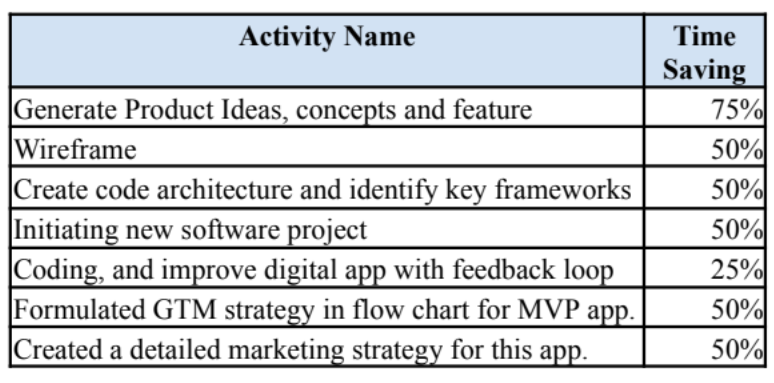
Accelerating New Product Development: A Vision on Active Personas | SpringerLink
venus-user Local PDF: Accelerating_New_Product_Development__A_Vision_on_Active_Personas-Preprint.pdf In this paper, we propose Active Personas (APs), fictional users capable of generating contextual feedback through an interactive multi-modal interaction, such as text, voice, image, and video.
Observations for Descriptive Synthesis
- in the spreadsheet
Using Generative AI to Create User Stories in the Software Engineering Classroom | IEEE Conference Publication | IEEE Xplore
venus-user This study investigates undergraduate computer science students using ChatGPT to create user stories from user feedback. Local PDF: Using_Generative_AI_to_Create_User_Stories_in_the_Software_Engineering_Classroom.pdf Observations for Descriptive Synthesis
- in the spreadsheet
Service-Oriented Requirements Elicitation Through Systematic Questionnaire Design: A Problem-Driven GenAI Approach | SpringerLink
Observations for Descriptive Synthesis
- We find that our Problem-Driven GenAI ques-tions significantly reduced the time and cost of generating questionnaires.
- However, ChatGPT is ineffective at understanding non-functional requirements and their practical applications.
PERSONÆR - Transparency Enhancing Tool for LLM-Generated User Personas from Live Website Visits | Proceedings of the International Conference on Mobile and Ubiquitous Multimedia
venus-user Local PDF: MUM24_paper_134.pdf
Observations for Descriptive Synthesis
- In the spreadsheet
PromptInfuser: How Tightly Coupling AI and UI Design Impacts Designers’ Workflows | Proceedings of the 2024 ACM Designing Interactive Systems Conference
venus-user Local PDF: 2310.15435v1.pdf Local PDF: 3643834.3661613.pdf
Observations for Descriptive Synthesis
- XX
Getting Inspiration for Feature Elicitation: App Store- vs. LLM-based Approach | Proceedings of the 39th IEEE/ACM International Conference on Automated Software Engineering
venus-user Local PDF: 2408.17404v1.pdf
Observations for Descriptive Synthesis
- The main advantage is thelarge knowledge about apps, what they offer and how users react to
7.1.2 Mining App Reviews. Reviews on app stores provide valuable insights from users, for example, the feature requests or bug re- ports, making them a valuable resource for requirements elicitation [18, 38]. Given the vast volume of app reviews, researchers have introduced numerous techniques to enhance the efficiency of their analysis. These techniques encompass the automatic classifications of app reviews into predefined category such as bug reports and feature requests [11, 31, 45, 50, 51]. Additionally, these methods employ clustering algorithms to assemble app reviews based on semantic similarity [12, 43, 46, 51], and also involve the generation of concise summaries of app reviews [12, 13, 22, 51]. These tech- niques are complementary to AppStore- and LLM-Inspiration as they bring the perspective and creativity of end users.
7.1.3Mining App Introduction Images. The app introduction im- ages on Google Play are a gold mine for the inspiration of app design, particularly the Graphical User Interface (GUI), as they are carefully selected by app developers to represent the important features of the apps. Recent researches mines the app introduc- tion images and proposed GUI search engines, such as Gallery D.C. [8, 15], and GUing [52], to facilitate the search of existing app UI designs using textual queries. Recently, Wei et al. discussed how LLM-Inspiration can be combined with GUI-Mining with the app designer in the loop [49].
Particularly since the release of ChatGPT, numerous studies have investigated the capacity of large language models (LLMs) for fa- cilitating requirements elicitation. For instance, Ronanki et al. [42] examined the potential of ChatGPT in assisting the requirements elicitation process, concluding that ChatGPT-generated require- ments are notably more abstract, atomic, consistent, correct, and understandable compared to those formulated by human experts. Gorer et al. [19] used LLMs for generating requirements elicitation interview scripts, demonstrating the model’s efficacy in enhancing the quality of these scripts. Cabrero-Daniel et al. [6] investigated the utilization of GPT-4 as assistants in agile software development meetings. Additionally, Marczak-Czajka et al. [33] applied ChatGPT to generate human-value user stories, thus providing inspiration for new requirements. In a similar vein, Zhang et al. [55] utilized GPT models to evaluate and refine the quality of user stories. Fur- thermore, Ataei et al. [5] developed multiple agents based on GPT-4, which facilitated the exploration of a broader range of user needs and unanticipated use cases. Recent work by Chen et al. [7] and Nakagawa et al. [36] has underscored the potential of generating goal models from given contexts using LLMs. These advancements collectively highlight the growing capability of LLMs in various aspects of requirements elicitation and analysis.
See: Researchers used LLMs, e.g. ChatGPT, to generateuser stories that describe candidate human values providing inspiration to stakeholder discussions [33] or to refine user stories and improve their quality [55].
[34]
[33] Agnieszka Marczak-Czajka and Jane Cleland-Huang. 2023. Using ChatGPT to Generate Human-Value User Stories as Inspirational Triggers. In 2023 IEEE 31st International Requirements Engineering Conference Workshops (REW). 52–61. https://doi.org/10.1109/REW57809.2023.00016 ISSN: 2770-6834
[55] Zheying Zhang, Maruf Rayhan, Tomas Herda, Manuel Goisauf, and Pekka Abrahamsson. 2024. LLM-based agents for automating the enhancement of user story quality: An early report. https://doi.org/10.48550/arXiv.2403.09442 arXiv:2403.09442 [cs]
Development of Data-driven Persona Including User Behavior and Pain Point through Clustering with User Log of B2B Software | Proceedings of the 2024 IEEE/ACM 17th International Conference on Cooperative and Human Aspects of Software Engineering
By entering thesesentences also into ChatGPT [11],
To review
The potential of generative artificial intelligence in leading a scalable agile enterprise by objectives - LUTPub #venus-roadmap googlescholar This master’s thesis explores the potential use cases of GAI to enhance cross-cutting leading by objectives in a scalable agile enterprise. Including managing objectives from strategic objectives to business objectives and individual development tasks using a digital objectives management tool. Local PDF: MasterThesis_Tuunainen_Henna.pdf
Product Requirements Reliability Analysis Based on Review Data and Entropy Weight TOPSIS | Proceedings of the 2024 International Conference on Generative Artificial Intelligence and Information Security (NEW) #venus-requirements Product Requirements Prioritization Local PDF: 3665348.3665364.pdf
ChatGPT in Product Management | SpringerLink #venus-user Local PDF: 978-3-031-45282-6_4.pdf
Deriving Domain Models From User Stories: Human vs. Machines | IEEE Conference Publication | IEEE Xplore #venus-user Based on a benchmark dataset that consists of nine collections of user stories and corresponding domain models, the evaluation indicates that no approach matches human performance, although a tuned version of the machine learning approach comes close.
--- batch2
Drawback:
LLM Generated Persona is a Promise with a Catch
https://arxiv.org/html/2503.16527v1
Deus Ex Machina and Personas from Large Language Models: Investigating the Composition of AI-Generated Persona Descriptions | Proceedings of the 2024 CHI Conference on Human Factors in Computing Systems #venus-user Local PDF: 3613904.3642036.pdf
Beyond Code Generation: An Observational Study of ChatGPT Usage in Software Engineering Practice | Proceedings of the ACM on Software Engineering #venus-user Local PDF: 3715111.pdf
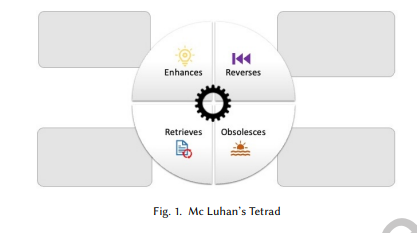 Sim, talvez por causa do Roadmap, e pode dar aquele contexto adicional, das fronteiras
Not Selected After Further Review
A Cross-Disciplinary Knowledge Management Framework for Generative Artificial Intelligence in Product Management: A Case Study From the Manufacturing Sector - ProQuest #venus-roadmap googlescholar Local PDF: 8d30b50f3d647a5d2e14208fa62b13b4.pdf
… This article explores the complex relationship between artificial intelligence and knowledge management, focusing on the practical application of machine learning models in a business context. It discusses various evaluation methods, operationalization challenges, and monitoring and observability techniques for such models…
The primary objective of the project, which serves as a case study in this research, is to increase profits by reducing communication costs and modifying discount policies.
Does not have GenAI as primary method. The experiment is not related to GenAI and lack of details.
Early Results from a Study of GenAI Adoption in a Large Brazilian Company: The Case of Globo | SpringerLink #venus-user
(PDF) AI-Driven Customer Journey Mapping for Enhanced Product Lifecycle Management and Sales Forecasting ?? Acho que foi google scholar e venus-roadmap R: Baixa qualidade
Unveiling Customer Needs: A Comprehensive Exploration of Jobs to be Done Interviews | Proceedings of the 7th ACM/IEEE International Workshop on Software-intensive Business #venus-user False-positive
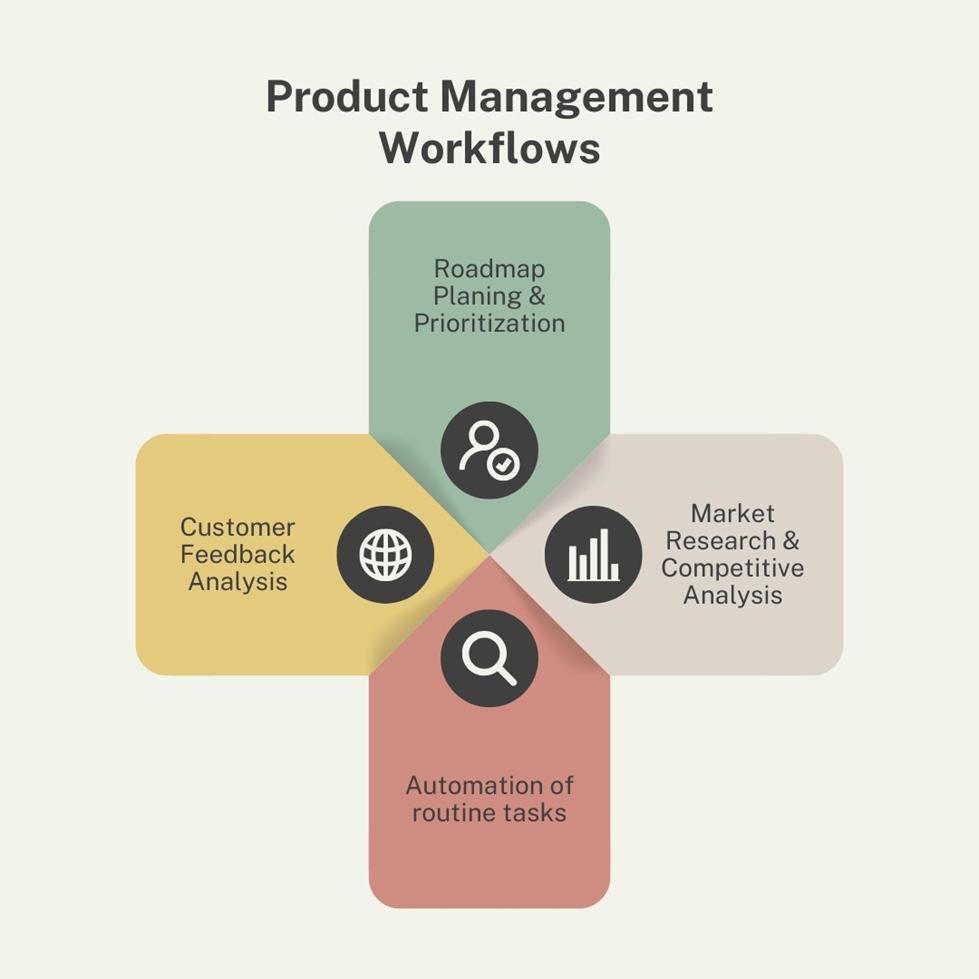
FROM INTUITION TO INTELLIGENCE: HOW AI IS RESHAPING PRODUCT MANAGEMENT WORKFLOWS | Request PDF #venus-roadmap googlescholar Local PDF: IJARET_16_01_027.pdf
Muito fraco o paper
Would like access to review
Generative AI in Agile, Project, and Delivery Management | SpringerLink #venus-user
Not Selected
A FRAMEWORK FOR SUSTAINABLE PRODUCT DEVELOPMENT USING GENERATIVE AI https://trepo.tuni.fi/bitstream/handle/10024/162548/SandbhorAmit.pdf?sequence=2 #venus-roadmap googlescholar
Accelerating Product Success: Designing a Digital Adoption Framework to Elevate Developer Experiences | SpringerLink #venus-roadmap googlescholar
Analysing the Role of Generative AI in Software Engineering - Results from an MLR | SpringerLink #venus-user Local PDF: PaulClarke_2.pdf
Value-Based Adoption of ChatGPT in Agile Software Development: A Survey Study of Nordic Software Experts | SpringerLink #venus-user (3) administrative tasks involving meetings, emails, and technical writing are seen as the blue ocean, offering significant value with relatively lower setup complexity.
How Can Generative AI Enhance Software Management? Is It Better Done than Perfect? | SpringerLink #venus-user
Speeding Up the Engineering of Interactive Systems with Generative AI | Companion Proceedings of the 2023 ACM SIGCHI Symposium on Engineering Interactive Computing Systems #venus-user …We explore how GenAI and LLMs can potentially speed-up the ideation, requirements elicitation, architecture development, prototyping, implementation, and testing of interactive systems.
How To Get Good At Data: 5 Steps | Proceedings of the 7th ACM/IEEE International Workshop on Software-intensive Business #venus-user boundaries
Workshop: Designing with AI-based tools | Adjunct Proceedings of the 2024 Nordic Conference on Human-Computer Interaction #venus-user Local PDF: 3677045.3685449.pdf
Interesting things on internet
Promptframes: Evolving the Wireframe for the Age of AI - NN/g
Stopped here
Consumer segmentation with large language models - ScienceDirect #venus-user
Generative AI for growth hacking: How startups use generative AI in their growth strategies - ScienceDirect #venus-user
Full article: Generative AI and ChatGPT: Applications, challenges, and AI-human collaboration #venus-user
Full article: Generative artificial intelligence-guided user studies: an application for air taxi services #venus-user