PRISM
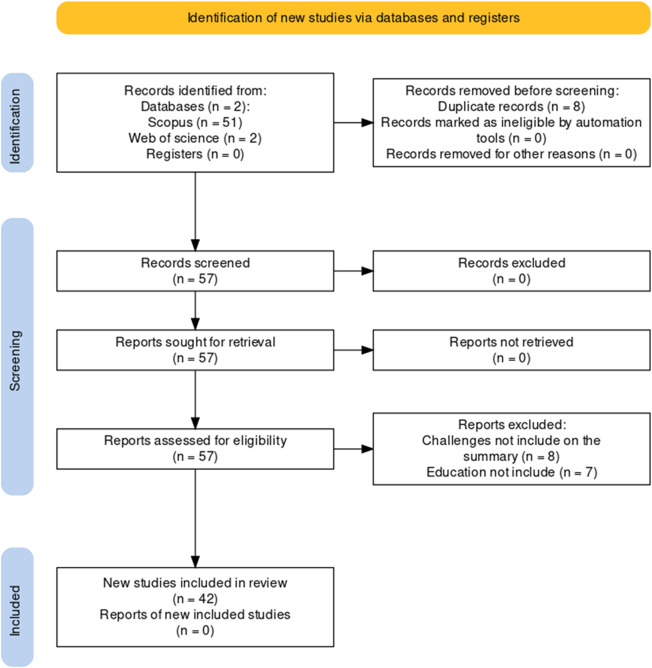 https://www.sciencedirect.com/science/article/pii/S2666374024000839#sec0009
PICOC
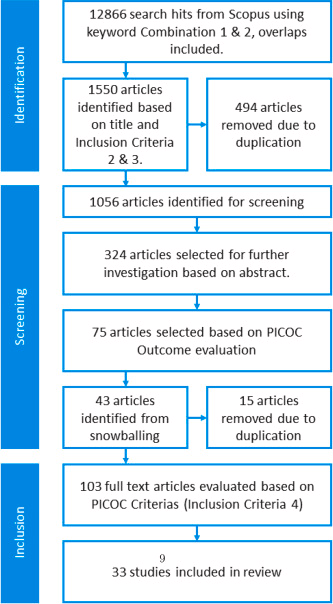 Src: https://www.sciencedirect.com/science/article/pii/S2451958825000193#sec3
https://drive.google.com/drive/search?q=SEEA_SLR%20parent:11eCxOHNDZd-g5s4ONTem7losDdS2y_A6
We explored the checklists and frameworks for quality assessment of primary studies recommended in [16, 18]. Among the most applicable frameworks for this study were: Critical Appraisal Skills Programme (CASP)[24]; and Standard Qual- ity Assessment Criteria (SQAC)[25]. The SQAC criteria was adopted, as it has a subset designed for quantitative studies. As the criteria were mainly oriented towards medical studies such as randomized controlled trials, we followed the guidance in [26, 27] to adapt it our scope by adjusting the wording of some criteria, and eliminating irrelevant criteria. The criteria are scored on a 3-point Likert scale, with zero points for unmet criteria, one point for partially met, and two points for met criteria. The quality score of each individual study is calculated by summing its scores in each criterion, dividing the sum by the maximum possible score for all criteria combined, and then multiplying the result by 100. Studies with quality scores less than 60% will be excluded from this review. The assessment criteria used for this review are listed in table III [26]. The quality assessment of the search results is to be carried out by two researchers. In case of disagreement, opinions of the other two researchers are considered to reach a resolution.
[16] J. P. T. Higgins, J. Thomas, J. Chandler, M. Cumpston, T. Li, M. J. Page, and V. A. Welch, Cochrane Handbook for Systematic Reviews of Interventions. John Wiley & Sons, Sep. 2019.
[17] B. Kitchenham and S. Charters, “Guidelines for performing Systematic Literature Reviews in Software Engineering,” vol. 2, Jan. 2007. Local PDF: 525444systematicreviewsguide.pdf
[26] L. Kmet and R. Lee, “Standard Quality Assessment Criteria for Eval- uating Primary Research Papers from a Variety of FieldsAHFMRHTA
[27] B. Kitchenham, “Procedures for Performing Systematic Reviews,” Keele, UK, Keele Univ., vol. 33, Aug. 2004.
To evaluate the quality of the articles, a checklist suitable for observational studies was adopted. The Strengthening the Reporting of Observational Studies in Epidemiology checklist (STROBE) was used, which comprises of six scales: title, abstract, introduction, methods, results, and discussion. In total, this checklist consists of 32 subscales (items). These 32 items include various methodological aspects of the study, including the title, statement of the problem, study objectives, type of study, statistical population of the study, sampling method, determining the appropriate sample size, definition of variables and procedures, study data collection tools, statistical analysis methods and findings. A point was awarded for each item that a study fulfilled. Accordingly, each study could achieve a score between 0 and 32. Articles with a score of 16 and above were deemed to be average and high-quality articles. Studies with a score of less than 16 were considered to be of low methodological quality and were therefore excluded from the Systematic Review.