Literature review for the theme Literature review for the research method
From Helenas Paper
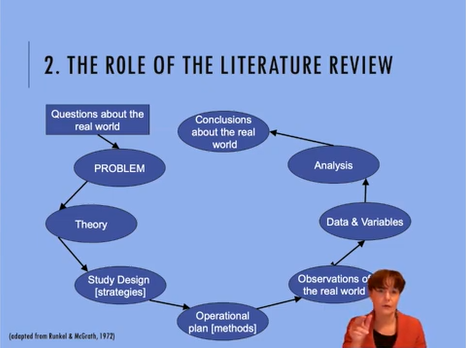
The stages associated with planning the review are:
- Identification of the need for a review
- Development of a review protocol. The stages associated with conducting the review are:
- Identification of research
- Selection of primary studies
- Study quality assessment
- Data extraction & monitoring
- Data synthesis.
teria. CRC [12] suggests the following checklist: • What are the review’s objectives? • What sources were searched to identify primary studies? Were there any restrictions? • What were the inclusion/exclusion criteria and how were they applied? • What criteria were used to assess the quality of primary studies and how were they applied? • How were the data extracted from the primary studies? • How were the data synthesised? How were differences between studies investigated? How were the data combined? Was it reasonable to combine the studies? Do the conclusions flow from the evidence?
Prof Anne-Wil Harzing
https://harzing.com/blog/2017/02/using-publish-or-perish-to-do-a-literature-review

 Parei 8:46
Helena Holmström Olsson - Orientation
From: Helena Holmström Olsson <helena.holmstrom.olsson@mau.se>
Date: Monday, 2 December 2024 at 15:56
To: Emil Johansson (2) <emil.johansson.2@volvo.com>
Cc: jan.bosch@chalmers.se (jan.bosch@chalmers.se) <jan.bosch@chalmers.se>
Subject: SLR paper examples
Hi Emil,
Really nice to meet with you today!
As promised, here are a few examples of SLRs:
Analytics and Data-Driven Methods and Practices in Platform Ecosystems: a systematic literature review SEEA_SLR.pdf
S Hegazy, C Elsner, J Bosch, HH Olsson
2023 49th Euromicro Conference on Software Engineering and …, 2023•ieeexplore.ieee.org
The emergence of platform ecosystems has transformed the business landscape in many industries, giving rise to novel modes of interorganizational cooperation and value co-creation, as well as unconventional challenges. The vast traces of data generated by platform ecosystems makes them ripe for the use of analytics and data-driven methods aimed at improving their health, performance, business outcomes, and evolution. However, the research on the application of analytics within platform ecosystems is limited and spread across multiple disciplines. To address this gap, we conducted a systematic literature review on the application of analytics and data-driven methods and practices within platform ecosystems. A total of 56 studies were reviewed, and underwent data extraction, analysis, and synthesis processes. In addition to presenting themes and patterns in the recent and relevant literature on platform ecosystems analytics, our review offers the following outcomes: an actionable overview of the analytics toolbox currently used within platform ecosystems—spanning domains such as machine learning, deep learning, data science, modelling, simulation, among others—; a roadmap for practitioners to achieve analytics maturity; and a summary of underexplored research areas.
Local: “H:\My Drive\02.04 Education_PapersVault\SEEA_SLR.pdf”
Empirical studies of agile software development: A systematic review
Author links open overlay panelTore Dybå, Torgeir Dingsøyr
https://doi.org/10.1016/j.infsof.2008.01.006Get rights and content
Agile software development represents a major departure from traditional, plan-based approaches to software engineering. A systematic review of empirical studies of agile software development up to and including 2005 was conducted. The search strategy identified 1996 studies, of which 36 were identified as empirical studies. The studies were grouped into four themes: introduction and adoption, human and social factors, perceptions on agile methods, and comparative studies. The review investigates what is currently known about the benefits and limitations of, and the strength of evidence for, agile methods. Implications for research and practice are presented. The main implication for research is a need for more and better empirical studies of agile software development within a common research agenda. For the industrial readership, the review provides a map of findings, according to topic, that can be compared for relevance to their own settings and situations.
https://www.diva-portal.org/smash/get/diva2:1409466/FULLTEXT01.pdf
SLR guidelines:
Also, this paper helps you with guidelines for including non-scientific literature (if you would want to) in a literature review:
https://arxiv.org/pdf/1707.02553
I hope this helps and please don’t feel you have to read everything. I provide examples and you decide what is relevant to you!
Kind regards,
Helena